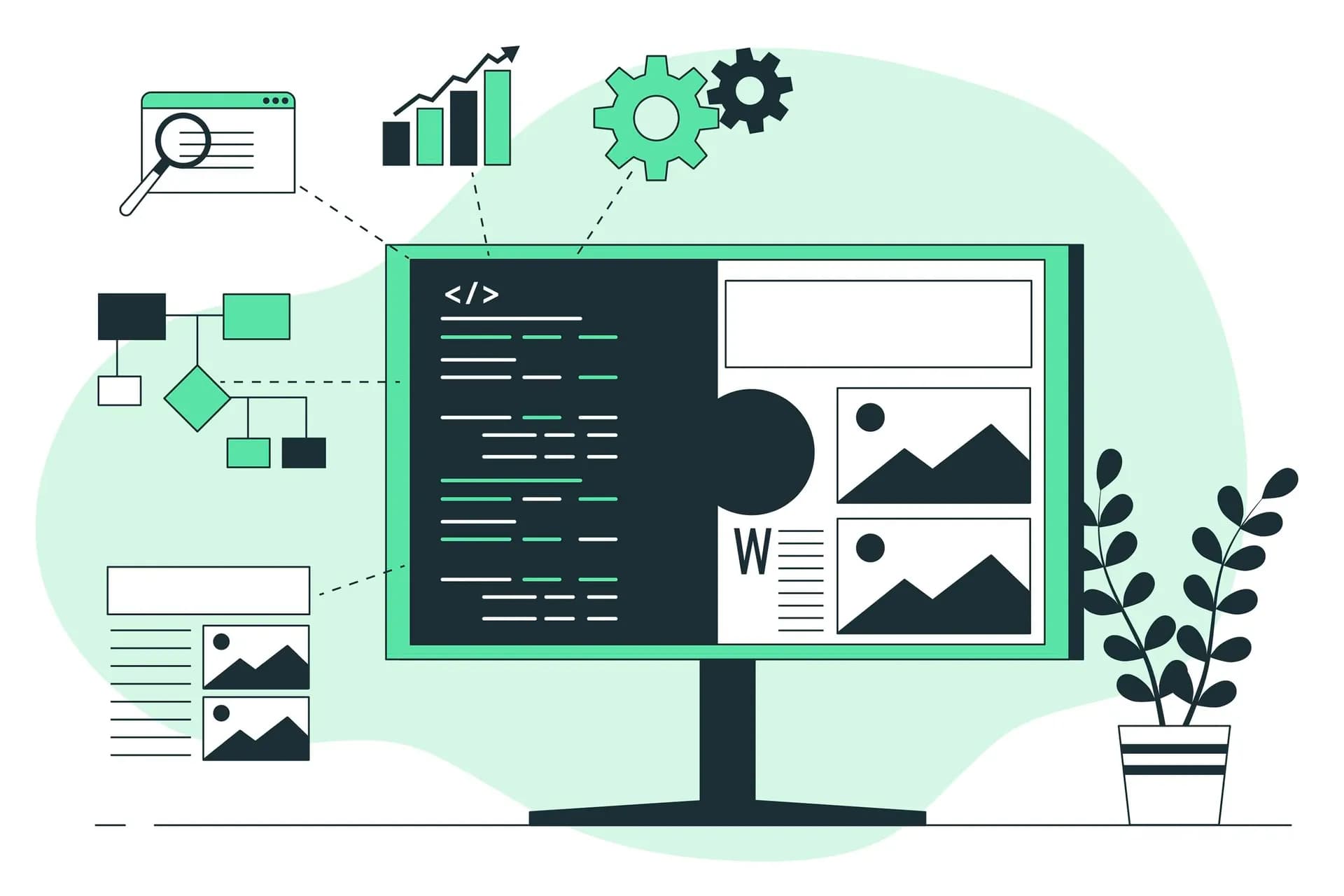
Why software architecture isn't just a technical term but your business advantage
Imagine you've decided to build a house. You could try to save money by not hiring an architect and start building right away. But what will happen? Without proper planning the foundation may turn out too weak, the walls may not bear the load of the roof and the utilities will have to be redone several times.
The same thing happens with software. Software architecture is the foundation your product is built on. Ignoring this aspect often leads to colossal losses of time and money and, in the worst case, to the complete failure of the project.
According to the analyst firm Gartner, almost 70% of IT projects exceed budget or deadlines precisely because of errors at the architectural planning stage. And if, as a business owner, you have to rely on external developers, understanding the basic principles of software architecture will help you:
- Avoid unnecessary rework costs
- Build a product that's easy to scale
- Reduce the cost of further maintenance
- Respond faster to market changes
Let's figure out what this "magic" called software architecture is and how it can help your business, even if you're far from programming.
What software architecture is and why it's critically important?
Software architecture is a high-level plan for organizing a system that defines its structure, behavior and the interaction of its components. Put simply, it's the "blueprint" of your digital product.
What is it for, for your business?
Imagine you're commissioning the development of a CRM system for your business. Here's how a well-founded architecture will help you in this case:
- Savings in the long run: a properly designed system requires fewer resources for maintenance and updates. According to IBM research, fixing architectural errors at the design stage costs 100 times less than after the product launches.
- Scalability: is your business growing? A well-designed system grows with you without the need for a complete rewrite.
- Security: architectural decisions directly affect your system's protection against cyberattacks.
- Time to market: a clear architecture lets you work on different components in parallel, speeding up development.
"Business owners often don't realize that wrong architectural decisions at the start of development are like a house built on sand. It may look great, but the first storm will lead to disaster." — a technical director.
Main architectural patterns and their business benefits
An architectural pattern is a time-tested solution to typical problems in software design. Let's look at the most common ones and their benefits for business.
1. Monolithic architecture: when simplicity is your advantage
What is it? The whole program works as a single block of code. All functions are tightly coupled and run in a single process.
Business benefits:
- The fastest and cheapest initial development
- Simpler testing
- Easier to implement for small projects
Business risks:
- Hard to scale as the business grows
- Hard to make changes without the risk of breaking the whole system
- The whole system is vulnerable to failures
A real-life example: A small online store with daily traffic of up to 1000 users can work perfectly well as a monolith. This lets it launch quickly with minimal investment.
2. Microservice architecture: flexibility for a growing business
What is it? The program is split into small, independent services, each responsible for a specific business function and able to be developed, deployed and scaled separately.
Business benefits:
- High flexibility — you can quickly make changes to individual parts of the system
- Excellent scalability — you can easily increase capacity only where it's needed
- Fault tolerance — a problem in one service doesn't stop the whole system
- The ability to use different technologies for different components
Business risks:
- A higher initial development cost
- More complex coordination between services
- Potentially higher infrastructure requirements
A real-life example: One of our clients, a restaurant chain, started with a monolithic system but eventually moved to microservices. When they expanded to 25 locations, it became critical to be able to update the booking system without affecting the inventory management system. The microservice architecture let them add new features 3 times faster than before.
3. Serverless architecture: pay only for what you use
What is it? A model where the cloud provider dynamically manages resource allocation and you don't have to worry about servers. You pay only for the resources actually used.
Business benefits:
- Low initial costs — no need to pay for idle servers
- Automatic scaling
- A focus on business logic rather than infrastructure
Business risks:
- Dependence on the cloud provider
- Potentially higher costs at large scale
- Not suitable for all types of applications
A real-life example: For our client who runs seasonal sales, a serverless architecture became the ideal solution. Their site gets 20 times more traffic during sales than on ordinary days. With serverless they pay for computing resources only when they're really needed, saving up to 70% on hosting compared with traditional solutions.
SOLID principles: a reliable foundation for any software product
If architectural patterns are the general plan of a building, the SOLID principles are the quality standards for every brick of your software. These are five basic principles of object-oriented design, and following them makes code clearer, more flexible and easier to maintain.
How do the SOLID principles affect your business?
Without going into technical detail, here's what these principles give your business:
- S (Single Responsibility) — the single responsibility principle
- Business benefits: It's easier to make changes without the risk of breaking existing functionality
- What it means for you: When you need to add a new feature, it will take less time and money
- O (Open/Closed) — the open/closed principle
- Business benefits: New features are added through extension rather than modification of existing code
- What it means for you: Fewer bugs during updates and faster release of new features to the market
- L (Liskov Substitution) — the Liskov substitution principle
- Business benefits: Guarantees the system works correctly when it's modified
- What it means for you: Lower risks when scaling the product
- I (Interface Segregation) — the interface segregation principle
- Business benefits: Different types of users get only the functions they need
- What it means for you: A clearer, more efficient interface for end users
- D (Dependency Inversion) — the dependency inversion principle
- Business benefits: High-level modules don't depend on low-level modules
- What it means for you: Easier replacement of technologies or service providers without reworking the whole system
"When developers follow the SOLID principles, we see support costs fall by up to 40% in the long run." — a Project Manager at our agency.
Mini case: How architectural decisions saved our client's business
Problem:
Our client, a chain of fitness centers, came to us after a bad experience with a previous contractor. Their membership management and class booking system kept failing during peak load periods (usually at the start of the year, when many people promise themselves they'll take up sports).
In addition, any change in one part of the system caused problems elsewhere, which made introducing new features an extremely slow and risky process.
Solution:
After a detailed analysis we proposed:
- Move from a monolithic to a microservice architecture, splitting the system into independent components:
- A membership management service
- A class booking service
- A payment service
- A notification service
- Introduce SOLID principles, focusing especially on separation of responsibility and reducing dependencies between modules.
- Introduce caching to reduce the load on the database at peak hours.
- Use cloud hosting with automatic scaling to manage the load.
Results:
- System stability rose to 99.9%, even during peak load
- Release time for new features fell from 3–4 weeks to 3–5 days
- Support costs fell by 35%
- User satisfaction rose by 47% according to a survey
- Business growth: fewer technical problems let the chain open 3 new locations without having to scale its IT team
Checklist: how to evaluate the quality of the architecture proposed by an IT contractor?
Here's a simple checklist that will help you assess whether a contractor takes your software's architecture seriously:
1. Planning and documentation
- The contractor proposes an architecture analysis and planning stage before development begins
- Clear documentation is presented, describing the architecture and justifying the choices
- There is a scaling plan for the system as the business grows
2. Approach to security
- Security is considered at the architectural level, not as an "extra feature"
- There's a clear data management strategy and data protection
- Regular security audits are provided for
3. Flexibility and scalability
- The architecture lets you add new features without a complete rework of the system
- Provision is made for horizontal scaling as load grows
- Business needs that may arise in the future are taken into account
4. Maturity of the approach
- The contractor can explain architectural decisions in simple, clear language
- Has successful cases of implementing a similar architecture
- Offers alternative options with the pros and cons of each
5. Technical debt
- The proposal accounts for a technical debt management strategy
- Time is allotted for refactoring and improving the system
- Regular code review and adherence to quality standards are provided for
How to save on development without harming the architecture
We understand that budgets are limited, especially for small and medium businesses. Here are a few tips for saving money without sacrificing architecture quality:
1. An MVP approach with the right priorities
Start with a minimum viable product (MVP) but don't skimp on the architectural foundation. Features can be added gradually, but the foundation must be solid from the start.
2. Use ready-made solutions where it makes sense
Don't reinvent the wheel. For many standard features there are proven solutions:
- Authentication systems
- Payment gateways
- Notification systems
3. Moderate use of "trendy" technologies
Don't chase the newest technologies just because they're trendy. Time-tested solutions are often more stable and cheaper to maintain.
4. The right development sequence
- First — the architecture and the basic structure
- Then — the key business functions
- Next — additional features and UX improvements
- Last — visual refinements and optimizations
5. Constant monitoring and early problem detection
Invest in monitoring and logging systems. Finding architectural problems at an early stage will save you huge amounts of money in the future.
Working with our agency: an architectural approach to software development
At our agency we always start projects with careful architectural planning, even if the client doesn't ask for it. We're convinced it saves our clients money and time in the long run.
Our development process with an emphasis on architecture:
- Discovery phase (2–3 weeks)
- Analysis of business requirements
- Market and competitor research
- Defining functional and non-functional requirements
- Architecture planning (1–2 weeks)
- Choosing the optimal architecture
- Creating a high-level system design
- Making key technology decisions
- Risk assessment and mitigation planning
- Iterative development
- Developing functionality by priority
- Regular testing and code review
- Continuous integration and delivery (CI/CD)
- Support and development
- Performance monitoring
- Planned technical debt management
- Regular architecture review when scaling
"We see ourselves not just as contractors but as the architects of your digital success. Our task isn't simply to write code but to build a reliable foundation for your business in the digital space." — Oleksii Kostunov, CEO of our agency.
Conclusion: software architecture is an investment, not an expense
To sum up, it's worth stressing: software architecture isn't a technical whim of developers but a critically important investment in your business's future.
The right architectural decisions let you:
- Grow faster and adapt to market changes
- Reduce long-term maintenance and scaling costs
- Keep the system running stably even as load grows
- Reduce the risks and technical problems that could harm your business's reputation
Don't skimp on the foundation of your digital business. Invest in quality architecture today to avoid painful and expensive rework tomorrow.
Need a consultation on software architecture for your project?
Our team is ready to help you analyze your project and design an optimal architecture that meets your business goals.
Book a free consultation or send a request through the form below