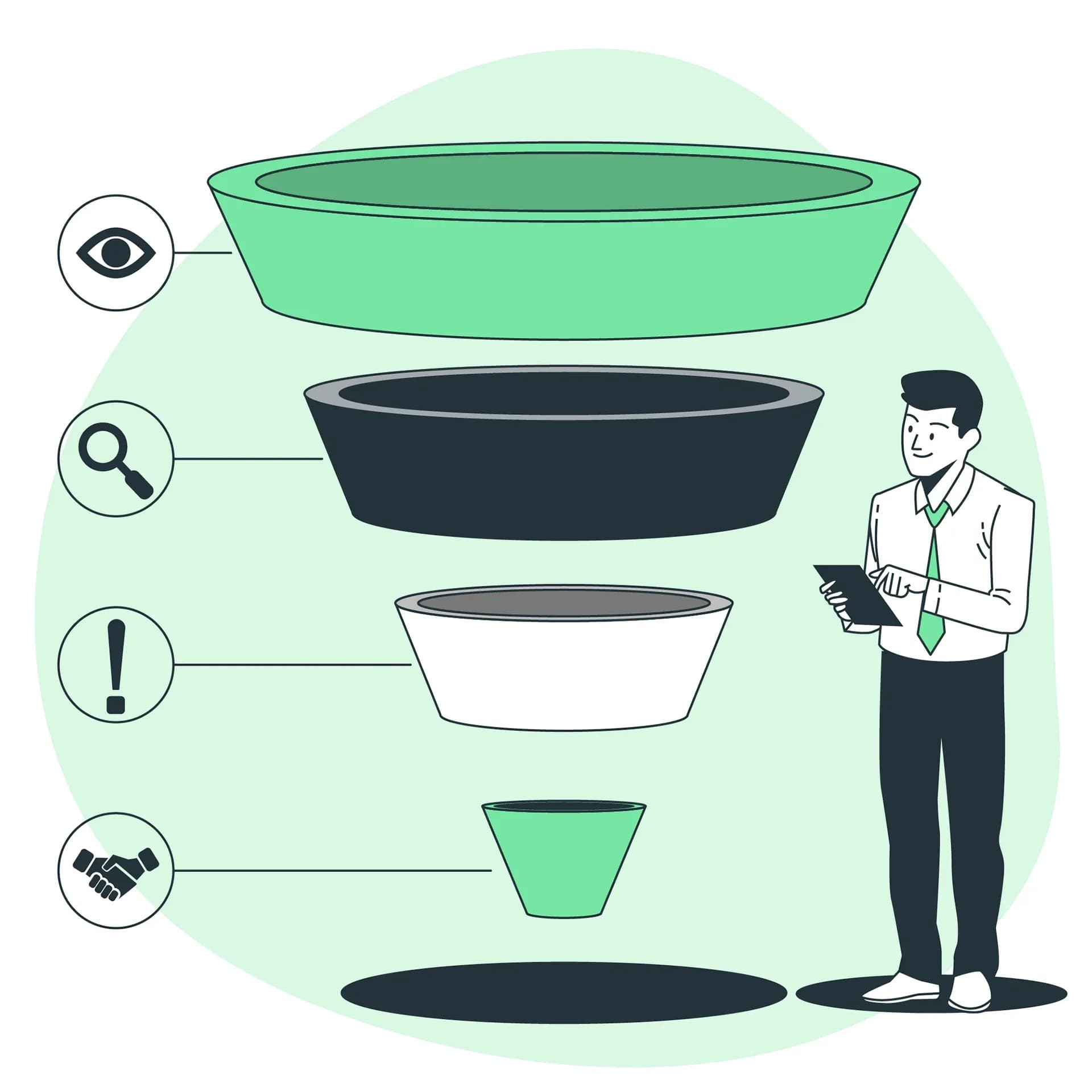
A sales funnel on a website isn't just a trendy marketing term. It's a proven tool that turns casual visitors into loyal customers. But do you know how to build such a funnel properly for your business?
What is a sales funnel and why is it important for your website?
Remember how, just a few years ago, it was enough to simply have a business-card site to attract customers? Today we're talking about complex marketing strategies, automation and personalization! So what is a sales funnel and why does your business lose money without one?
A sales funnel is the sequential path a potential customer takes from first getting to know your brand to making a purchase and continued interaction. Picture an ordinary funnel: wide at the top (many potential customers) and narrow at the bottom (those who made a purchase).
Most entrepreneurs focus only on attracting traffic but wonder why conversions stay low. The thing is, an effective sales funnel through a website is much more than just attractive design and quality content.
According to statistics, 96% of website visitors aren't ready to buy on their first visit. That's exactly why a structured sales funnel becomes a decisive factor in an online business's success.
The structure of an effective sales funnel: 5 stages that work on any site
1. The awareness stage: attracting the target audience's attention
At this stage potential customers are only just learning that your brand or product exists. Your task is to attract attention and get them interested.
What works at the awareness stage:
- SEO-optimized content that answers popular queries
- Useful blog articles that solve the audience's problems
- Video content on YouTube and other platforms
- Social media activity
- Targeted advertising to a cold audience
A practical example: a sports nutrition online store creates a series of informative articles about proper nutrition for beginner athletes, optimized for key queries such as "sports nutrition for beginners", "how to start eating right while training", etc.
2. The interest stage: turning visitors into subscribers
Once a visitor has become interested in your content, it's time to offer them additional value in exchange for contact details. This will let you continue the conversation outside the site.
Tools for collecting contacts:
- Useful e-books or checklists
- Mini-courses or webinars
- Personalized calculations or quizzes
- A discount on the first order
- Pop-up forms with relevant offers
A practical example: the same sports nutrition store offers a free PDF guide, "A 7-day meal plan for gaining muscle mass", in exchange for the visitor's email.
3. The decision stage: demonstrating the product's value
At this stage the potential customer is already considering a purchase but comparing different options. Your task is to convince them that your product best meets their needs.
Effective elements for the decision stage:
- Detailed product pages that emphasize benefits
- Reviews from real customers and case studies
- Comparison tables with competitors
- Product demonstrations (video, photos, 3D models)
- Detailed answers to frequently asked questions
A practical example: the protein page features real "before and after" photos, customer transformations, a detailed composition, comparison with alternatives and athletes' reviews.
4. The action stage: simplifying the buying process
When the decision is almost made, it's important to simplify the path to purchase as much as possible and remove every possible obstacle.
Key elements for conversion:
- A clear, noticeable call to action (CTA)
- A simplified checkout form
- A variety of payment methods
- Clear information about delivery and returns
- Confirmation of purchase security
A practical example: the store introduced one-step checkout with one-click purchase for registered users, added secure payment methods and free delivery for orders over UAH 1,000.
5. The loyalty stage: turning customers into brand advocates
Acquiring a new customer costs 5–7 times more than retaining an existing one. So it's important to build relationships with customers after the purchase.
Strategies for raising loyalty:
- Email campaigns with personalized offers
- A loyalty program with bonuses and discounts
- An invitation to a private community
- After-sales follow-up and support
- Encouraging customers to leave reviews and referrals
A practical example: after purchase the customer receives a series of emails with product usage recommendations, an invitation to a private Telegram group for athletes and bonus points for every order.
How to optimize a sales funnel: 3 proven methods
1. Analyze and measure effectiveness
You can't improve what you don't measure. For effective sales funnel optimization you need to analyze key metrics regularly:
- The conversion rate at each stage
- The bounce rate on key pages
- Average customer acquisition cost (CAC)
- Average order value and LTV (customer lifetime value)
- ROI of marketing campaigns
Tip: set up Google Analytics 4 with additional goals to track how users move through the funnel. Create a dedicated dashboard for monitoring key indicators.
2. Test different elements of the funnel
A/B testing is a reliable way to check which elements of the sales funnel work better. Test regularly:
- Headlines and subheadings
- Calls to action (text, color, placement)
- Lead capture forms (number of fields, design)
- Different value propositions
- Pricing and product packaging options
A practical example: an online store tested two versions of a landing page: with a product video review and without it. The version with the video showed a 28% higher conversion to subscriptions.
3. Implement automation
Modern marketing automation tools let you create a personalized experience for every visitor while saving your time.
What can be automated:
- Email campaigns based on user behavior
- Retargeting campaigns
- Personalized product recommendations
- Collecting reviews after purchase
- Welcome emails and onboarding series
Tip: start with basic email marketing automation. Create a series of 5–7 emails for new subscribers that will guide them through the sales funnel to their first purchase.
Typical mistakes when building a sales funnel through a website
1. Focusing on the product rather than the customer's needs
Many companies talk about their product's features and forget to explain which problems it solves. An effective sales funnel always starts with understanding your target audience's pain points and needs.
How to fix it: survey your customers to understand their real motivations. Rewrite content with an emphasis on benefits rather than features.
2. No clear call to action
You'll be surprised how many sites have no clear CTA or hide it somewhere in the footer. A sales funnel on a website must offer the user a clear next step at every stage.
How to fix it: add prominent buttons with clear calls to action on all key pages. Check that the CTA matches the funnel stage the user is at.
3. A complicated checkout process
According to statistics, 69% of users abandon their cart because of a complicated or lengthy checkout process. This is a critical point in your sales funnel through the website.
How to fix it: minimize the number of form fields, add guest checkout, provide a variety of payment methods and transparent delivery information.
Tools for building an effective sales funnel
Analytics and tracking
- Google Analytics — for general tracking of user behavior
- Hotjar — for viewing heatmaps and session recordings
- Google Tag Manager — for easily adding various tracking scripts
Automation and email marketing
- MailChimp or SendPulse — for basic email marketing automation
- GetResponse — for building landing pages and automated sequences
- ActiveCampaign — for complex automation with CRM integration
Conversion elements
- OptinMonster — for creating pop-ups and lead capture forms
- Thrive Leads — for a variety of subscription forms for WordPress
- Calendly — for easy consultation booking
Summary: where to start building a sales funnel?
Building an effective sales funnel through a website isn't a one-off project but a constant process of optimization. Here's your action plan for the next month:
- Week 1: analyze the existing site and identify the key user entry points
- Week 2: create a value proposition for each stage of the funnel
- Week 3: implement the basic elements (subscription forms, CTAs, product pages)
- Week 4: set up analytics and launch the first A/B tests
Are you already working on a sales funnel for your website? Which elements give the best results?
Interested in learning more about digital marketing? Read our articles on website SEO optimization and email marketing.